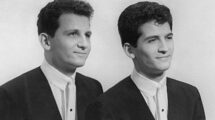
Rock and roll group formed in the mid-‘50s by Vern Ruppert and Terry Elton. Originally a five-man group they soon added horns. An early line-up included Ruppert (guitar), Elton (lead vocals), with Denny Weston (bass), Preston Hutt (piano), and LeRoy Cornell (drums). Soon they added Drew Lawrence and his “raunchy” saxophone added a new dimension to the group.


Left: Preston Hutt
Above: Eddie Macon
The group evolved and members came and went. Leroy Cornell and Denny Weston moved on and were replaced by Sonny Riffici on drums, and Ed Macon on rhythm guitar. The group was really jelling at this point but something happened and Sonny had to move on and was replaced by Buddy Merkel. Buddy brought a new energy and sound to the group and the demand for their services grew.
Bud added “I joined The Londonaires as their drummer in the winter of 1957 and stayed with the band as the drummer and co-manager through the 1960’s. The photo of “The Londonaires” in the Tru-fit gold jackets was taken while I was the drummer and as a matter of fact resulted in the purchase of a new set of gold sparkle Ludwig drums from Ted’s Music Shop (“the musician’s friend”) on Centre Street. Incidentally, I still have the jacket, albeit a little small for me now. I am currently retired and living in Arizona where I still have a working band modeled after “The Londonaires”. We call ourselves “The Roadrunners” and do strictly music from the 50’s and 60’s.

Back: Hutt, Macon, Ruppert.
“Unfortunately, the names of the trumpet and trombone players have been lost in time and that is a sad thing because they were really good” recalled Elton… “On the gigs where they played “Jumping at Woodside” as the opening number and it rocked the house!”
Ron Sechrist (sax ex-Rockets) was also noted as a member.
The Londonaires performed on the Buddy Deane Show and worked many of Deane’s record hops in Baltimore and the Eastern Shore of Maryland. They also appeared on the Dick Clark Show (while Clark was struggling in Philadelphia).
“The Londonaires were an extraordinarily popular band in Baltimore during the late ‘50s and early ‘60s” adds Elton. “The thing that made the group unique and so popular was that we could do all the top rock and roll numbers for the younger set and yet still play the dance band tunes for the adults… The Londonaires played all over Baltimore and surrounding areas and… were able to overcome many of the challenges that early rock and roll bands had to face. At one gig at a teen center we arrived with a black backup singer and were told we couldn’t perform. The contract called for The Londonaires and he was a Londonaire so we all started to leave. After some discussion with the people running the center, he was allowed to come in but he could not leave the stage and could not use the restroom. That was just one of the problems we faced. In the ‘50s and early ‘60s you had to play two fast tunes and then one slow and there was no room for variation… one New Years Eve we opened with a solid half hour of really up-tempo tunes… by then the plugs had been pulled and the Londonaires never worked that venue again!”
“The group was easy to spot because of our gold shantung jackets and our white convertibles which set us apart from every other band in Baltimore at the time.”

The Londonaires made several recordings at United Recording Studio in Washington, DC. (including their song “Dead Beat”) although none of the acetates survive today.
For a long time the Londonaires rehearsed in the studios of WCAO and had very close contact with some of the top DJs in Baltimore at the time Ed Graham, Les Alexander, Jack Dawson, and even Buddy Dean.
Ruppert later managed the RaVons. He also did recordings and A&R work at Dave Smith’s garage “studio” in the Park Heights area. In addition, Vern wrote songs for recording artist Dick Charles. He later worked as a DJ using the professional name Vern Charles. Macon joined the Sentries in 1961. He was also a member of the Lafayettes, Fugitives, The Package, and Tony Vee & the Zodiacs. Cornell played in the rhythm section backing the Cardinals, and later played for the Tren-dells. Weston went on to join Ralph Emmel & the Counts. He played for many groups including the Crystals, Tommy Vann’s Professionals, Joy, and Dion’s Streetheart Band… Sechrist played for the Centaurs, Joyriders, Original Realistics… Merkle played with many other groups. In ‘00s he played with an Arizona based ‘50s revival group called the Roadrunners.
Group members eventually spread all over the United States: AZ, CA, KS, and MD, but continued to stay in touch. In mid-‘00s they reunited and played a Sock Hop in the Towson High cafeteria where they had performed back in 1957. The dance drew over 300 of their loyal fans.